| Previous Story: 42 | Next Story: Blink |
| Previous in Production: Blink | Next in Production: 42 |
|
Modern Series Episodes 37 & 38: Human Nature / The Family Of Blood
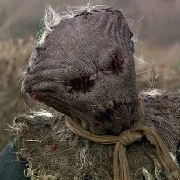
At Farringham School for Boys in 1913, teacher John Smith dreams of being an adventurer in time and space known as “the Doctor”. One of the maids, Martha Jones, watches warily as Mr Smith grows close to Joan Redfern, the school nurse. Oft-bullied student Tim Latimer, who sometimes experiences flashes of preternatural insight, suspects that something is very odd about a fob watch Mr Smith keeps on his mantel. And in the neighbouring fields, one of Tim's tormentors, Baines, finds an invisible spaceship. Soon Farringham is overrun with animated Scarecrows, as the cruel Family of Blood hunts for a Time Lord...
Between 1991 and 1997, Virgin Publishing released sixty-one novels in the Doctor Who: The New Adventures range of original fiction. Designed to continue the adventures of the Seventh Doctor beyond the apparent end of the television series with Survival in 1989, the line frequently courted controversy by targeting an older audience and boasting mature content. But it also enjoyed considerable critical acclaim, and witnessed the first professional Doctor Who work of eventual television contributors such as Russell T Davies, Mark Gatiss, Matt Jones and Gareth Roberts. Perhaps the most popular of the New Adventures was Paul Cornell's Human Nature, published in May 1995. It was voted the all-time best of the series according to Doctor Who Magazine balloting in 1998, and also maintained the pole position in the online Doctor Who Novel Rankings survey through to the final edition in 2006. His fourth contribution to the New Adventures, Human Nature had been plotted by Cornell with the help of Kate Orman -- another of the range's luminaries -- and several other Australian fans during a stay in Sydney. Human Nature saw the Doctor accompanied by Bernice “Benny” Summerfield, whom Cornell had created specifically for the New Adventures in 1992. The story was inspired by the iconic “hero's journey” described by Joseph Campbell in his seminal 1949 work on traditional mythologies, The Hero With A Thousand Faces. Cornell was particularly interested in the stage known as the “apotheosis”, in which a hero gave up everything in order to gain enlightenment. Benny had endured the death of her lover in the previous New Adventures novel, David A McIntee's Sanctuary, and so Human Nature saw the Doctor transform himself into a human in order to comprehend what his companion was going through. With the Doctor now believing himself to be Aberdeen native “Dr John Smith”, he and Bernice -- posing as his niece -- settled at the Hulton Academy for Boys in Farringham, Norfolk during the spring of 1914. Under the looming spectre of the First World War, the Doctor fell in love with widowed science teacher Joan Redfern. He and Benny were also pursued by the shapeshifting alien Aubertides, who sought the receptacle containing the Doctor's true personality, which was disguised as a cricket ball.
Human Nature had always been a favourite of Cornell's, and he imagined adapting it for television while contemplating a potential revival of Doctor Who during the late Nineties. It was also well-regarded by Davies, who thought along similar lines after he was appointed the executive producer of Doctor Who in 2003. Soon after the completion of Cornell's first televised Doctor Who script, 2005's Father's Day, Davies asked him to turn Human Nature into a two-part story. The intention was for it to occupy a pivotal spot in Season Twenty-Nine and, as such, the adaptation was one of the earliest commissions for the 2007 slate. Cornell began writing his scripts around May 2006. Consideration was given to eliminating the use of any computer-generated effects, but this approach was ultimately abandoned. Fearing that a straight adaptation of Human Nature would be too old-fashioned for Doctor Who's modern storytelling sensibilities, Cornell struggled with the construction of his narrative. At one point, for instance, the adventure opened with the Doctor already married to Joan Redfern. However, Davies encouraged Cornell to hew more closely to his novel. Later, Cornell had the timeline for the episodes stretch over several weeks to provide time for John Smith's courtship of Joan to play out, but it was found that this deprived the action of much of its intensity. Instead, Cornell invested a lot of the emotion which would have been derived from the development of Smith and Joan's relationship into the “flash-forward” sequence late in Episode Two. Some aspects of Human Nature could easily be altered to suit the screen: Benny was replaced by Martha Jones, who would pretend to be the Doctor's maid instead of his niece. The Doctor's human persona became simply “Mr John Smith” so that he would not be referred to by other characters as “Doctor”. His birthplace was given as Nottingham to reflect David Tennant's desire to continue using the English accent he had adopted for Doctor Who. The receptacle for the Doctor's identity was now a pocketwatch, since it was something which could actually be opened. Cornell also eliminated various subplots found in his novel, including those involving a doomed suffragette named Constance; Benny's landlord, Alexander Shuttleworth, who discovered that she was a time traveller; and an ersatz future Doctor. Other changes were more significant, however. The Aubertides of the novel were creatures whose entire being was an extension of their form, even including their clothes and possessions. Cornell tried to make this idea work on screen, such as by giving Lucy a sentient, attacking balloon, and having Martha realise that Jenny was an alien when her friend reacted with pain after Martha spilt tea on her handbag. It was ultimately decided that this notion worked better in prose than on television, and so the Aubertides were replaced by the Family of Blood. Their eerie, idiosyncratic habit of referring to each other by their family relationship was Davies' suggestion. The short lifespan of the revised antagonists also provided the new motivation for the Doctor's metamorphosis. Davies still wanted some kind of traditional monster in the story, and so the Family's scarecrow servitors -- originally robots -- were conceived.
Some of the characters from the novel reappeared in Cornell's scripts under altered names, such as the bullied Timothy Dean becoming Tim Latimer. The setting was now simply called the Farringham School for Boys. Martha's family was included in the narrative at one stage, since an early idea for the character was that she would actually come from 1914. Although early drafts set the action during the summer of that year, the setting was eventually shifted back to the gloom of Winter 1913. The cliffhanger at the end of Episode One initially focussed on Smith being faced with the decision of ordering the schoolboys to open fire on the Family. For a long time, the young girl corrupted by the Family was called Lucy Wainwright. However, it was noted that the surname was also being used later in the season for a character in Blink, so she became Lucy Cartwright instead. By the time the shooting scripts were issued on November 20th, it had been decided that the adventure should pay homage to two figures who had been instrumental in the earliest days of Doctor Who. In the novel, John Smith had given the names of his parents as Harry and Sarah Jane, in reference to former companions Harry Sullivan and Sarah Jane Smith. In the television version, however, they would become Sydney and Verity. Sydney Newman had been the BBC's Head of Drama in 1963, when he set into motion the development of the programme which ultimately became Doctor Who. He had hired Verity Lambert to be its very first producer. While Episode One retained the name Human Nature, the second installment became known as The Family Of Blood. An early version of the Season Twenty-Nine transmission schedule positioned them in the fourth and fifth slots, which were ultimately occupied by Helen Raynor's Daleks In Manhattan / Evolution Of The Daleks. It was eventually decided that Human Nature / The Family Of Blood should instead be the eighth and ninth episodes, closing the distance to the reappearance of the Chameleon Arch -- which transformed the Doctor into human form -- in episode eleven, Utopia. Cornell's adventure was originally intended to form the season's fifth production block but, when the recording dates for Blink were moved up, it exchanged designations with Human Nature / The Family Of Blood and the latter became Block Six. The director would be Charles Palmer, who had just finished Smith And Jones and The Shakespeare Code, the year's first two stories.
Because of the need to record the 2006 Christmas special and all thirteen episodes of Season Twenty-Nine in just nine months, a double-banking approach would be employed, as had been the case during the making of Season Twenty-Eight. This meant that Human Nature / The Family Of Blood would made in parallel with Blink, in which the Doctor and Martha hardly appeared. To ease the burden on regular producer Phil Collinson, Susie Liggat was named the producer for Cornell's scripts. She had recently handled the same duties on Invasion Of The Bane, the pilot episode of The Sarah Jane Adventures which would be transmitted on New Year's Day 2007. Liggat had also worked as a first assistant director on Doctor Who, initially receiving a credit on 2006's Love & Monsters (although Army Of Ghosts / Doomsday had actually been made first). For Human Nature / The Family Of Blood, Collinson would instead be credited as an executive producer. Recording began on November 27th, when Martha's scenes in the TARDIS were filmed at Doctor Who's regular studio home in Upper Boat. To represent Farringham School, Palmer combined three different locations. The first was Llandaff Cathedral in Cardiff; the team spent November 28th there, recording material in the dormitory and on the staircase. The major venue, however, was Treberfydd House in Llangors, where cameras rolled from November 29th to December 5th, omitting only Sunday the 3rd. Constructed in the mid-nineteenth century, it offered areas suitable for the entrance hall, Martha's room, the armoury, some corridors, the playing field, the rear of the school, and the courtyard. The third location used for Farringham School was Tredegar House in Newport. On December 6th, Palmer filmed various corridor sequences there, plus the Mother chasing Martha, and the “flash-forward” shot of Smith and Joan with their first child. The next three days -- the 7th to the 9th -- were spent at Upper Boat, chiefly for sequences in Smith's study. His A Journal Of Impossible Things was prepared by artist Kellyanne Walker; in addition to depictions of various monsters which had appeared in Doctor Who since its 2005 return, Walker also included sketches of the nine previous Doctors. This was the first visual reference in the revived programme to any of the actors who had played the Doctor before Christopher Eccleston in 2005. The Doctor's messages to Martha were also taped on the standing TARDIS set on the 9th. More school corridor scenes were filmed at Tredegar House on December 11th, along with those in Smith's classroom, Smith's death in 1963, and the Daughter's imprisonment in the mirror. The 12th saw Palmer's team at work in a number of Cardiff locations. First, Llandaff Cathedral provided the war memorial, as well as the setting for Smith and Joan's wedding. Next, the modern corridor in Tim's vision of Martha was found at BBC Broadcasting House, where the Father also met his final fate. Lastly, the First World War battlefield was constructed on the premises of Neal Soil Suppliers, where cast and crew had to contend with the accumulated mud from a fortnight of near-constant rain. The production then moved to the open-air St Fagans National History Museum in Cardiff from December 13th to 15th. It offered suitable village exteriors, as well as the dance hall. Following the Christmas break, production resumed at Upper Boat on January 3rd, 2007 with sequences inside the Family's spaceship. This set was actually a redressed version of a portion of the Hub, the headquarters used by Captain Jack Harkness and his team in the spin-off series Torchwood. Then it was back to St Fagans on January 4th, 5th, 7th and 8th; on the latter day, time was also spent at Cwm Ifor Farm in Caerphilly for Tim's farewell to the Doctor and Martha. Upper Boat was once again the venue on January 9th and 10th, for scenes in the Cartwrights' cottage. Part of the second day was also spent back at Cwm Ifor Farm, for the sequence in which Smith and Joan encountered the scarecrow in the field. All of the remaining footage was then completed at Upper Boat, beginning with TARDIS scenes on January 11th. For the second time since work had begun on Season Twenty-Nine, Tennant was experiencing voice problems related to a bad cold, so his material was deferred to the 17th. Finally, various inserts were recorded on February 5th and 23rd. Human Nature was then broadcast on May 26th, followed by The Family Of Blood on June 2nd. Doctor Who now settled at 7.10pm, after having been shifted around the Saturday schedule over the preceding several weeks.
|
|
||||||||||||||||||||||||||||||||||||||||||||||||||||||||||||||||||||||||||||||||||||||||||||||||||||||||||||||||||||||||||||||||||||||||||||||||||||||||||||||||||||||||||||||||||||||||||||||||||||||||||||||||||||||||||||||||||||||||||||||||||||||||||||||||||||||||||||||||||||||||||||||||||
| Updated 7th June 2022 |
| Return To | ||
|---|---|---|
| Main Page | Episode List | Season 29 |
| Previous Story: 42 | Next Story: Blink |
| Previous in Production: Blink | Next in Production: 42 |