| Season Seven (1970): Exiled To
Earth |
| Companions and Recurring Characters |
|
Early in the season, Peter Bryant and Derrick Sherwin were both abruptly
moved to another programme. Appointed to replace them was Barry Letts (bio), who had previously directed The Enemy Of The World for the series.
Together, he and Terrance Dicks became one of the longest-lasting
production teams in Doctor Who's history, remaining intact
throughout the Pertwee era.
|
|
|
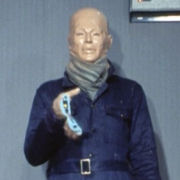
Spearhead From Space by Robert Holmes,
directed by Derek Martinus
The newly-regenerated Doctor is exiled to modern-day Earth by the Time
Lords, where he becomes attached to the British branch of UNIT as their
scientific adviser, ostensibly taking orders from Brigadier
Lethbridge-Stewart. The Doctor's first task is to investigate a shower
of strange plastic meteorites which landed in the countryside. Nearby, a
dollmaker named Ransome discovers that his plastics factory has been
taken over by a mysterious man called Channing. Now its corridors are
stalked by deadly animated mannequins called Autons, who are determined
to recover the last of the meteorites.
|
Cambridge scientist Liz Shaw joins UNIT as the Doctor's assistant.
|
|---|
|
|
|
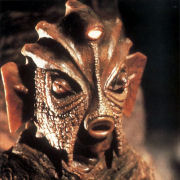
The Silurians by Malcolm Hulke,
directed by Timothy Combe
UNIT is called to a nuclear reactor on Wenley Moor, which has been
plagued by strange power disruptions and a wave of nervous breakdowns.
The Doctor suspects a connection with a nearby network of caves, and is
stunned to find a dinosaur hunting in the tunnels. He discovers that the
reactor has inadvertently awakened the Earth's original inhabitants: the
reptilian Silurians, who have lain underground in suspended animation
for millions of years. Now the Doctor must determine whether there is
any possibility for peace between the two races -- or whether a
catastrophic conflict is inevitable. (Also known as Doctor Who and
The Silurians. This story has been recolourised, as the original
prints are missing.)
|
|
|
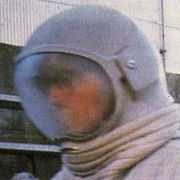
The Ambassadors Of Death by David
Whitaker, directed by Michael Ferguson
A manned mission to the Red Planet, Mars Probe 7, is returning to
Earth, but there has been no communication from the astronauts for
several months. Recovery 7 meets it in orbit, but then the signal
is suddenly cut off by an alien noise. When the recovery capsule touches
down, UNIT is ambushed and the occupants vanish. However, the Doctor and
Liz discover that the capsule interior is highly radioactive: whatever
came down in Recovery 7 couldn't possibly have been human. As the
Doctor searches for the missing astronauts, he begins to realise that he
is up against a vast conspiracy reaching into outer space. (Episode
one is retained in its original colour, while episodes two to seven have
been recolourised, as the original prints are missing.)
|

|
|
Inferno by Don Houghton, directed by
Douglas Camfield
Project Inferno is designed to drill down through the Earth's core,
where it will release a powerful new energy source called Stahlman's
Gas, named after the project's director. But the Doctor realises that
unleashing Stahlman's Gas will have horrible consequences for the
planet, and indeed his fears are confirmed when a substance oozing up
from the drill shaft begins mutating men into bestial monsters. Before
the Doctor can do anything to stop Stahlman, however, a power surge in
the TARDIS console sends him to a hostile parallel universe where
Project Inferno is nearing completion.
|
|
The changes envisaged over the course of the previous year came to
fruition with Season Seven: Doctor Who was now in colour, with a
new Doctor exiled to modern-day Earth, working alongside Brigadier
Lethbridge-Stewart and UNIT. The revamped format lent itself to new
producer Barry Letts' vision of the Doctor Who target audience as
consisting of teenagers and even adults, rather than younger viewers. As
a result, Doctor Who became a more mature, adventure-oriented
programme featuring heavier doses of horror and violence.
|
| Season Eight (1971): Enter -- The
Master |
| Companions and Recurring Characters |
|
Josephine (Jo) Grant was the Doctor's
assistant during much of his tenure as UNIT's scientific advisor.
Katy Manning (bio) made her first appearance as Jo
in Terror Of The Autons (January
1971) and her last in The Power Of The
Doctor (October 2022).
|
|

|
|
Captain Mike Yates of UNIT was Brigadier
Lethbridge-Stewart's second-in-command for part of the Doctor's exile to
Earth.
Richard Franklin (bio) made his first appearance as
Yates in Terror Of The Autons
(January 1971) and his last in Dimensions
In Time (November 1993).
|
|

|
|
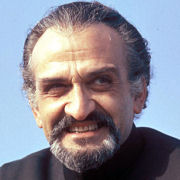
The Master was a renegade Time Lord driven
by a thirst for power at any cost.
Roger Delgado (bio) made his first appearance as the
Master in Terror Of The Autons
(January 1971) and his last in Frontier In
Space (March 1973).
|
|
|

|
|
Terror Of The Autons by Robert Holmes,
directed by Barry Letts
The Doctor is warned of the arrival on Earth of a terrible new threat.
The murderous renegade Time Lord known as the Master has stolen a
Nestene energy unit and established a base of operations at a plastics
factory where he has placed the owner, Farrel, under his mental
influence. When the Doctor's new assistant, Jo Grant, stumbles upon the
Master, she too is hypnotised, with orders to trigger a lethal trap for
the Doctor. But this is not the only snare the Master has prepared for
the Doctor, even as he plots a new Nestene invasion of the Earth.
(This story has been recolourised, as the original prints are
missing.)
|
With Liz Shaw having returned to Cambridge, Jo Grant replaces her.
|
|---|
|
|
|
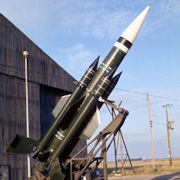
The Mind Of Evil by Don Houghton,
directed by Timothy Combe
At Stangmoor Prison, the Doctor and Jo attend a demonstration of the
Keller Machine, which purports to remove the negative impulses from the
human brain. However, when the Machine is activated, a man somehow dies
as if he had suffered his greatest fear. Meanwhile, the Brigadier is
responsible for security at the first-ever World Peace Conference, where
Captain Chin Lee of the Chinese delegation is conspiring to undermine
the negotiations. And, nearby, Mike Yates is preparing to escort a
deadly nerve gas missile scheduled for disposal. Connecting all
three events is the Master -- the evil mind behind the Keller Machine.
(This story has been recolourised, as the original prints are
missing.)
|
|
|
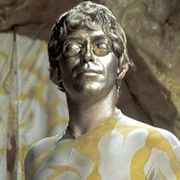
The Claws Of Axos by Bob Baker and
Dave Martin, directed by Michael Ferguson
A mysterious spacecraft arrives on Earth, bearing beautiful,
golden-skinned aliens who introduce themselves as Axons. They bring with
them a fantastic substance called Axonite, which can affect the
structure of matter. The Axons offer to provide the world with Axonite
as a solution to world hunger and myriad other problems. The Doctor is
suspicious, but his protests are overruled by a greedy ministry man
named Chinn, who places UNIT under arrest. Meanwhile, Jo goes in search
of US agent Bill Filer, who has become imprisoned within the spacecraft
-- where his cellmate is none other than the Master.
|
|
|
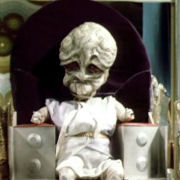
Colony In Space by Malcolm Hulke,
directed by Michael Briant
When the Master steals information about a doomsday weapon, the Time
Lords send the Doctor and Jo to the planet Uxarieus in the twenty-fifth
century. There, they discover an Earth colony struggling with the twin
perils of crop failure and death at the hands of what seems to be a
monstrous lizard. Meanwhile, agents of the Interplanetary Mining
Corporation have arrived on Uxarieus, asserting their right to drill for
valuable duralinium. The Doctor must discover what connects these events
with the Master -- and with the planet's primitive natives, who harbour
a terrible secret.
|
|
|
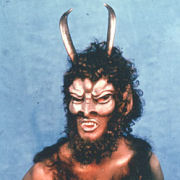
The Daemons by Guy Leopold, directed by
Christopher Barry
White witch Olive Hawthorne warns that dark forces are stirring in the
village of Devil's End, where the Master is posing as the new vicar. The
Doctor learns that Professor Horner, an archaeologist, is planning to
open an ancient barrow near the community. He and Jo race to stop
Horner, but they are too late and bizarre energies are loosed. A stone
gargoyle prowls Devil's End, doing the Master's evil bidding, while the
Brigadier discovers that an impenetrable heat barrier surrounds the
town. But the Doctor is convinced that these phenomena are just pretexts
to the arrival of a being older than humanity itself... (This story
has been recolourised, as the original prints are missing.)
|
|
With the Doctor, Brigadier Lethbridge-Stewart and Sergeant Benton now
joined by Jo Grant, Captain Yates and the Master, the “UNIT
Family” of characters was complete, setting the stage for three
years of remarkable stability under the guidance of Barry Letts and
Terrance Dicks. Although the Doctor Who production team would
later acknowledge that they had been unwise to use the Master in all
five of the year's stories, resulting in a certain amount of
predictability and overexposure, Season Eight nonetheless saw Doctor
Who's popularity on the rise once again.
|
| Season Nine (1972): A Galactic
Yo-Yo |
|
|
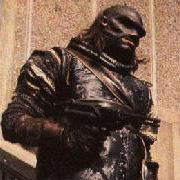
Day Of The Daleks by Louis Marks,
directed by Paul Bernard
Sir Reginald Styles is preparing to host a crucial international peace
conference when he is attacked by a man with futuristic weaponry -- who
suddenly vanishes. Soon thereafter, another guerrilla is murdered by
brutish Ogrons. The Doctor decides to pose as Sir Reginald, and is soon
confronted by more guerrillas. They come from the twenty-second century,
and have travelled back through time to kill Styles because they hold
him responsible for the devastation of their era. Jo inadvertently
activates one of their time machines and finds herself catapulted into a
future where the Earth is dominated by the Daleks!
|
|
|
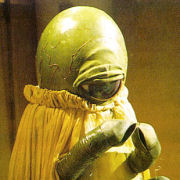
The Curse Of Peladon by Brian Hayles,
directed by Lennie Mayne
The planet Peladon is attempting the join the interstellar Federation.
Delegates from several worlds have come to meet with King Peladon --
including the Ice Warriors, led by Lord Izlyr. However, the high priest
Hepesh warns that the King's plans are risking the anger of the mythical
beast Aggedor. The delegates are saved from a falling statue only by the
intervention of the Doctor and Jo, whom the Time Lords have sent to
Peladon. When the life support system of delegate Arcturus is sabotaged,
the Doctor suspects Izlyr. But are his past experiences with the Ice
Warriors blinding him to the real villains?
|
|
|
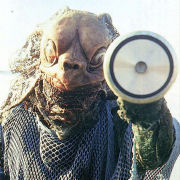
The Sea Devils by Malcolm Hulke,
directed by Michael Briant
Several ships have gone missing off the British coast, and the Doctor
suspects an unnatural cause. Investigating an old sea fort at the
epicentre of the disappearances, he comes face-to-face with the aquatic
cousins of the Silurians, nicknamed Sea Devils. Like the Silurians,
they have lain dormant for aeons in suspended animation, but have
recently been awakened. But even as the Doctor starts to formulate a
plan to achieve peace with the Sea Devil colony, the Master is plotting
too. Having duped the governor of the prison where he is incarcerated,
he now plans to help the Sea Devils destroy humanity.
|
|
|
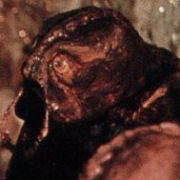
The Mutants by Bob Baker and Dave
Martin, directed by Christopher Barry
In the thirtieth century, Earth's decadent intergalactic Empire is in
its dying days, but the cruel Marshal clings to power over the planet
Solos. The Doctor and Jo arrive, tasked by the Time Lords with
delivering a mysterious message. They learn that unrest on Solos is
mounting as the Marshal tightens his grip, in defiance of orders from
Earth to grant its people their independence. At his behest, the
scientist Jaeger is conducting experiments to make the planet's
atmosphere more suitable for humans. But the Solonians blame these
trials for a virulent mutation, which is turning them all into hideous
monsters.
|

|
|
The Time Monster by Robert Sloman,
directed by Paul Bernard
The Master obtains the Crystal of Kronos and uses it to construct a
machine which lets him manipulate time. He succeeds in summoning an
Atlantean priest named Krasis to the present day, but his experiments
also alert the Doctor to his machinations. The Master's goal is to gain
control of Kronos, a Chronovore native to the time vortex. But Krasis
reveals that the Master only wields a fragment of the true Crystal,
which is held in Atlantis by King Dalios. With the almost limitless
power of Kronos within his grasp, the Master plunges back into antiquity
-- and the Doctor has no choice but to follow.
|
|
With Doctor Who's popularity on the rise once again, the
production team began to restore some of the elements which had been
deemphasised since the start of the Pertwee era. The year would not only
feature several trips in the TARDIS -- although the Doctor was still
unable to operate it independently -- but also the return of old enemies
like the Daleks and the Ice Warriors, in addition to the Master.
|
| Season Ten (1972-73): A Return To
Wandering |
|
|
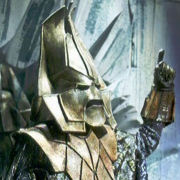
The Three Doctors by Bob Baker and Dave
Martin, directed by Lennie Mayne
UNIT headquarters is attacked a strange form of energy which the Doctor
believes has been sent to target him. He sends a distress signal to the
Time Lords, but their power is being drained through a black hole --
from which the attack on the Doctor also emanates. The Time Lords are
able to send the Second Doctor to assist the Third Doctor, while the
First Doctor advises them from the TARDIS scanner. The Doctors allow the
energy to teleport them through the black hole into a world of
anti-matter. There they discover Omega, an ancient Time Lord long
thought dead, who now wields absolute power over his new domain.
|
|
|
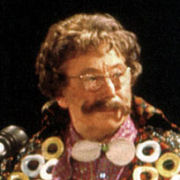
Carnival Of Monsters by Robert Holmes,
directed by Barry Letts
With the Doctor once again free to wander in time and space, the TARDIS
lands aboard the cargo ship SS Bernice. Jo believes that it is
1926, but the Doctor realises that the vessel is one which history
records as having disappeared without a trace. The mystery deepens when
a dinosaur attacks the Bernice -- after which the passengers and
crew obliviously start to repeat their recent actions. The Doctor
discovers that the ship is trapped inside a Miniscope: outlawed
technology owned by a travelling showman named Vorg. But the Miniscope
also houses the monstrous Drashigs, who threaten the lives of all those
imprisoned within.
|
|
|
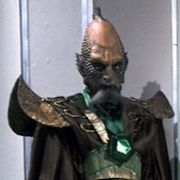
Frontier In Space by Malcolm Hulke,
directed by Paul Bernard
The Earth Federation is on the brink of war with the rival Draconian
Empire. When the TARDIS lands on an Earth spaceship in the midst of
an ambush, the Doctor and Jo realise that the crew perceives the
attackers to be Draconians when, in reality, they are Ogrons using a
hypnotic device. Unfortunately, the brainwashing also convinces the
humans that the Doctor and Jo are Draconian collaborators, and they are
sentenced to spend the rest of their lives in a lunar penal colony.
There they learn that it is the Master who's inflaming tensions between
the two space powers. But why?
|
|
|
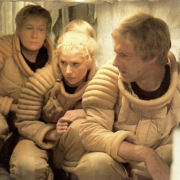
Planet Of The Daleks by Terry Nation,
directed by David Maloney
In pursuit of the Daleks who were working with the Master, the TARDIS
materialises on Spiridon. Jo leaves the unconscious Doctor behind while
she ventures into a hostile jungle, where she encounters a group of
Thals. Returning to the TARDIS, they reveal to the now-recovered Doctor
that their mission is to locate and destroy an army of ten thousand
Daleks, hidden somewhere on Spiridon. Poisoned in the jungle, Jo is
saved by Wester, one of the planet's invisible natives. The time
travellers discover that the Daleks intend to learn the secret of the
Spiridons' invisibility, rendering their army virtually unbeatable...
|
|
|
The Green Death by Robert Sloman,
directed by Michael Briant
While the Doctor explores the planet Metebelis Three, Jo and the
Brigadier travel to the Welsh village of Llanfairfach.
Lethbridge-Stewart is investigating reports of a dead miner whose corpse
glowed green, while Jo is interested in the work of Professor Jones, an
ecologist who has established the nearby Wholeweal community. The
Brigadier is rebuffed by Stevens, the director of Global Chemicals, who
receives orders from a mysterious boss. Convinced by Jones that Global's
waste is poisoning the local mine, Jo investigates. She discovers that
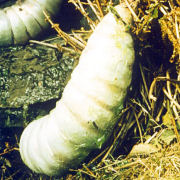
it is crawling with insects -- mutated into giant, green monsters.
|
Jo leaves UNIT to marry Professor Jones.
|
|---|
|
|
Doctor Who's milestone tenth season was celebrated in several
ways: The Three Doctors brought together
all three Doctors -- William Hartnell, Patrick Troughton, and Jon
Pertwee -- against the menace of the mad Time Lord, Omega, while the
combined narrative of Frontier In Space
and Planet Of The Daleks was intended to
challenge Season Three's The Daleks' Master
Plan as the longest Doctor Who story ever. However,
Season Ten was most notable for restoring the programme's original
format, as the Doctor's exile to Earth was rescinded and he became a
wanderer in space and time once again. Together with the departure of
Katy Manning at the end of the year, and the tragic death of Roger
Delgado in an automobile accident, this decision initiated the
dissolution of the UNIT Family, and heralded the beginning of the end of
the Pertwee era.
|
| Season Eleven (1973-74): Facing
Fears |
| Companions and Recurring Characters |
|
Sarah Jane Smith was a journalist who
stowed away aboard the TARDIS during an investigation. Even after
leaving the Doctor, she continued defending Earth from alien invasion
with the help of a group of teenagers and the robot dog K·9.
Elisabeth Sladen (bio) made her first appearance as
Sarah Jane in The Time Warrior
(December 1973) and her last in The End
Of Time (January 2010).
|
|

|
|
|
The Time Warrior by Robert Holmes,
directed by Alan Bromly
UNIT is called in when scientists begin disappearing from a top-secret
research establishment. The Doctor discovers that they are being
abducted into the past, and uses the TARDIS to follow them through time
-- not realising that he has a stowaway aboard in the form of journalist
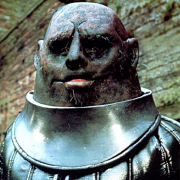
Sarah Jane Smith. Arriving in the Middle Ages, the Doctor tracks the
missing scientists to the castle of a warlord named Irongron. There he
discovers that Irongron is in league with a Sontaran, Linx, who has
crashlanded on Earth, and is now supplying the alien weaponry with which
Irongron is terrorising the English countryside.
|
Having helped defeat Linx, Sarah Jane is invited aboard the TARDIS.
|
|---|
|
|
|
Invasion Of The Dinosaurs by Malcolm
Hulke, directed by Paddy Russell
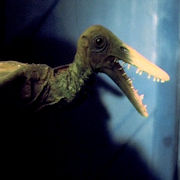
The Doctor and Sarah return to the present day, only to discover that
London is all but deserted. Arrested as looters, they are attacked by
dinosaurs while being taken to jail. Reunited with UNIT, the Doctor
realises that a device is being used to terrorise the city by reaching
into the Earth's past. He formulates a plan to track down those
responsible -- unaware that Captain Yates is part of the plot, and has
been tasked with sabotaging the Doctor's scheme. Meanwhile, Sarah Jane
is ambushed while investigating a possible lead. She wakes up to find
herself on a spaceship... which left Earth months earlier! (Episode
one has been recolourised, as the original print is missing.)
|
|
|
Death To The Daleks by Terry Nation,
directed by Michael Briant
The TARDIS suddenly loses power, and the Doctor and Sarah emerge to find
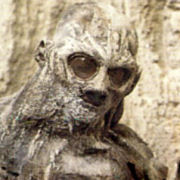
themselves trapped on the planet Exxilon. They meet a crew from Earth
which has come to Exxilon seeking parrinium, which is needed to cure a
virulent space plague. However, the humans are affected by the power
drain, too -- as are the Daleks, who have also arrived in search of
parrinium. The humans, the Daleks and the time travellers forge an
uneasy alliance against the violent natives of Exxilon. But the Daleks
are already plotting betrayal, and the Doctor is left with no choice but
to venture into the Exxilons' forbidden city in search of answers.
|

|
|
The Monster Of Peladon by Brian Hayles,
directed by Lennie Mayne
The TARDIS returns to Peladon fifty years after its first visit, and
Queen Thalira, daughter of King Peladon, is now the head of state. The
Galactic Federation desperately needs trisilicate -- in which Peladon is
rich -- to wage a war against the oppressive Galaxy Five. But this has
sparked dissension amongst Peladon's miners, inflamed by the
manifestation of the ghost of Aggedor, the Sacred Beast of Peladon, to
condemn the Federation. As Chancellor Ortron schemes for power, Alpha
Centauri is convinced to summon help. When the Ice Warriors arrive, the
Doctor is again suspicious of them; but is he repeating past mistakes?
|
|
|
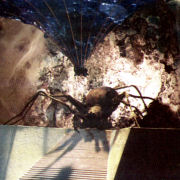
Planet Of The Spiders by Robert
Sloman, directed by Barry Letts
Mike Yates summons Sarah to a meditation centre, where he believes a man
called Lupton is up to no good. In fact, Lupton has gained fantastic
powers after bonding with one of the Spiders who rule the planet
Metebelis Three. Their mission is to find the blue crystal which the
Doctor stole from Metebelis Three, and recover it on behalf of the
mammoth Great One. Sarah is teleported to the Spiders' planet, where she
finds a regressive human colony living in fear. The Doctor has no choice
but to follow her -- setting the stage for an encounter with the Great
One that will change his life forever.
|
Radiation poisoning causes the Doctor to regenerate.
|
|---|
|
|
With Richard Franklin leaving Doctor Who this season, and Barry
Letts and Terrance Dicks finally prepared to dissolve the long-standing
production team, Jon Pertwee himself decided to leave the series, a
decision also mitigated by an unwillingness by the BBC to increase the
actor's salary. As a result, perhaps the most stable era of the show's
history ended on a high note, with the programme's popularity still
soaring. But the heights Doctor Who had reached thus far were
nothing compared to those it would soon attain...
|
|