| Season Twenty-One (1984): Change, My
Dear |
|
|
The Twin Dilemma by Anthony Steven,
directed by Peter Moffatt
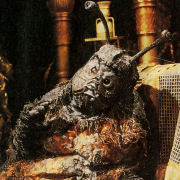
The Doctor experiences regenerative instability, prompting him to live
as a hermit amidst the desolation of Titan 3. There he rescues
Lieutenant Hugo Lang, the lone survivor of a pursuit squadron destroyed
by the immense power of the tyrannical Mestor. The Doctor learns that
Lang was trying to rescue twin mathematical geniuses named Romulus and
Remus Sylvest, and he recognises their kidnapper as his old friend, the
Time Lord Azmael, whom he thought retired to the planet Joconda. The
Doctor must discover the link between Mestor and Azmael, and the
terrible purpose Mestor intends for the Sylvest twins.
|
|
When the Sixth Doctor embarked on his first adventure in the 1984
finale, it was just the second time in Doctor Who's history
that a change of lead actor had occurred mid-season. The production
office hoped that this approach would provide audiences with a chance to
acclimate to the new TARDIS team prior to the long break before the
start of Season Twenty-Two.
|
| Season Twenty-Two (1985):
Instabilities |
| Companions and Recurring Characters |
|
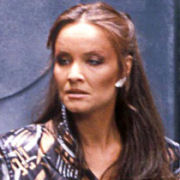
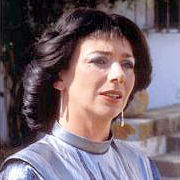
The Rani was a ruthless Time Lord scientist
who turned renegade in order to pursue her emoral experiments.
Kate O'Mara (bio) made her first appearance as the
Rani in The Mark Of The Rani
(February 1985) and her last in Dimensions
In Time (November 1993).
|
|
|
|
|
Attack Of The Cybermen by Paula Moore,
directed by Matthew Robinson
As Halley's Comet approaches the solar system in 1985, a strange force
causes the TARDIS to malfunction. The Doctor detects a mysterious signal
emanating from Earth, little realising that it's being transmitted by
the mercenary Lytton, who is posing as the boss of a criminal gang.
Meanwhile, Lytton has taken his cohorts into the London sewers, where
they find the Cybermen waiting for them. And, on the planet Telos, the
slave workers Bates and Stratton try to rebel against their Cyberman
masters. In order to understand the connection between these events, it
will fall to the Doctor to uncover Lytton's true loyalties.
|
|
|
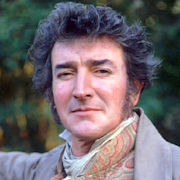
Vengeance On Varos by Philip Martin,
directed by Ron Jones
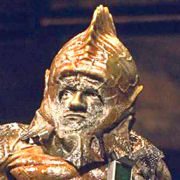
The TARDIS runs out of vital Zeiton-7 ore, so the Doctor makes an
emergency landing on the planet Varos, which is rich in the mineral.
Varos is a former penal colony, and its residents now derive pleasure
purely from televised tortures. The Governor of Varos is struggling to
negotiate a price for Zeiton-7 with Sil, the scheming representative of
the Galatron Mining Corporation. To placate his unhappy people, the
Governor orders the live execution of the rebel Jondar. When the Doctor
and Peri intervene, they are forced to navigate the Punishment Dome,
where they may become the latest victims of Varos' video nasties.
|
|
|
The Mark Of The Rani by Pip and Jane
Baker, directed by Sarah Hellings
The TARDIS arrives near the village of Killingworth at the time of the
Luddite uprisings. The local mine owner, Lord Ravensworth, alerts the
Doctor and Peri to a rash of violence which has recently erupted,
threatening the work of famed engineer George Stephenson. The Doctor
follows a series of clues to a bath house, where a renegade Time Lord
called the Rani lurks in disguise. She has been sending the miners into
a rage by harvesting brain chemicals for her amoral experiments. But the
Master is also present, scheming to harness Stephenson's genius for his
own use, and he and the Rani soon agree to join forces.
|
|
|
The Two Doctors by Robert Holmes,
directed by Peter Moffatt
The Time Lords send the Second Doctor and Jamie to Space Station Camera,
to put an end to dangerous temporal experiments. The Doctor appeals to
his old friend, Dastari, but is betrayed: Dastari has genetically
augmented a savage Androgum named Chessene, who has forged an alliance
with the Sontarans. The captive Doctor is taken to Seville, where
Dastari plans an operation to isolate the genetic code which permits
time travel. Suddenly gripped by a memory of being executed in his
second incarnation, the Sixth Doctor rescues Jamie and travels with Peri
to Seville -- where both his past and his future are at stake.
|
|
|
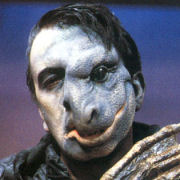
Timelash by Glen McCoy, directed by
Pennant Roberts
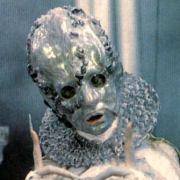
The TARDIS lands on the planet Karfel, which is under the sway of the
mysterious Borad. The Borad wields the power of a time tunnel called the
Timelash, through which foes are banished, never to return. When the
Borad kills the nominal ruler, Renis, and installs the scheming Tekker
in his place, Renis' daughter Vena steals a vital amulet and throws
herself into the Timelash. With Peri held prisoner, the Doctor agrees to
follow Vena's trail, and he finds her in the care of a young writer
named Herbert in nineteenth-century England. The Doctor convinces Vena
to return to Karfel... but neither Tekker nor the Borad is to be
trusted.
|
|
|
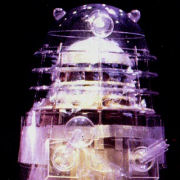
Revelation Of The Daleks by Eric Saward,
directed by Graeme Harper
On Necros, Davros is posing as the Great Healer of Tranquil Repose,
where dying patients sleep in suspended animation. He is allied with
Kara, whose company produces a food concentrate which has eliminated
famine in the galaxy. But Davros has become extortionate in his demands,
prompting Kara to send the disgraced knight Orcini to assassinate him.
Meanwhile, the Doctor and Peri arrive on Necros to attend the funeral of
an old friend, Arthur Stengos. Also present is Stengos' daughter,
Natasha, who discovers that her father has become a victim of Davros'
experiments to create a new race of Daleks...
|
|
Season Twenty-Two saw a mix of old and new for Doctor Who, as the
show returned to Saturday teatimes, but was now formatted as
forty-five-minute episodes. Despite this, things did not fare well for
the programme; ratings were down and there were renewed calls that
Doctor Who was becoming too violent. Combined with financial
issues within the BBC and a disregard for Doctor Who by senior
administrators, this cluster of circumstances led BBC management to
delay the resumption of filming by a year. All of the stories originally
planned for Season Twenty-Three would be cancelled. Furthermore, it was
made clear that Doctor Who would now have to justify its
continued existence, or be removed from the schedules again --
permanently.
|
| Season Twenty-Three (1986): On
Trial |
| Companions and Recurring Characters |
|
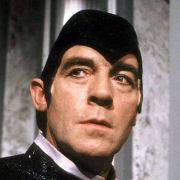
The Valeyard was a Time Lord who prosecuted
the Doctor at his trial, until he was revealed to be some form of
aberrant version of the Doctor from the future.
Michael Jayston (bio) played the Valeyard in The Trial Of A Time Lord (September to
December 1986).
|
|
|
|
The Inquisitor was a Time Lord who presided
over the Doctor's trial with cold efficiency.
Lynda Bellingham (bio) played the Inquisitor in The Trial Of A Time Lord (September to
December 1986).
|
|

|
|
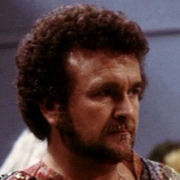
Sabalom Glitz was an intergalactic
mercenary and pirate who sometimes helped and sometimes hindered the
Doctor -- but always with his own best interests in mind.
Tony Selby (bio) made his first appearance as Glitz
in The Trial Of A Time Lord
(September 1986) and his last in Dragonfire (December 1987).
|
|
|
|
Melanie Bush, also known as Mel, was a
computer programmer from Earth gifted with an eidetic memory.
Bonnie Langford (bio) made her first appearance as
Melanie in The Trial Of A Time
Lord (November 1986) and her last in The Giggle (December 2023).
|
|

|
|
The rapport between John Nathan-Turner and Eric Saward had been slowly
deteriorating for years, but the tumultuous production of Season
Twenty-Three placed new strains on their relationship from which they
were unable to recover. Fed up with a series of decisions to which he
strenuously objected, Saward quit Doctor Who. This forced
Nathan-Turner to assume the dual roles of producer and script editor for
the latter part of the troubled season.
|
|
|
The Trial Of A Time Lord (Segment One)
by Robert Holmes, directed by Nicholas Mallett
An amnesiac Doctor is put on trial for his life by a Time Lord
Inquisitor. The prosecutor, the sinister Valeyard, uses the Matrix to
show the court the Doctor's recent adventure on the planet Ravolox.
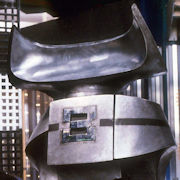
There, the robot Drathro rules an underground civilisation, but is now
malfunctioning after centuries of operation. On the surface live the
warlike Queen Katryca and her Tribe of the Free. They capture Peri and
imprison her with Glitz and Dibber, two off-world conmen who have come
to steal Drathro's secrets. Meanwhile, the Doctor discovers evidence of
an impossible connection between Ravolox and Earth.
|
|
|
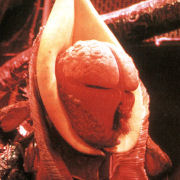
The Trial Of A Time Lord (Segment Two)
by Philip Martin, directed by Ron Jones
At the Doctor's trial, the Valeyard presents the Doctor and Peri's most
recent adventure. On the trail of arms merchants, they arrive on
Thoros-Beta, home of the Mentors -- including their old foe, Sil. There
they are attacked by a genetically-modified monster created by the
scientist Crozier. He is searching for a way to save Kiv, the Mentor
leader, whose enhanced intelligence is now causing his brain to outgrow
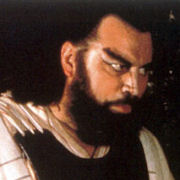
his skull. Peri forges a reluctant alliance with a brash and headstrong
warlord named King Yrcanos. But the Doctor is subjected to mind-altering
technology... and appears to cast his lot with Crozier and the Mentors.
|
|
|
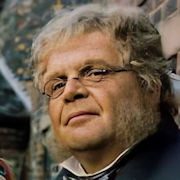
The Trial Of A Time Lord (Segment
Three) by Pip and Jane Baker, directed by Chris Clough
To make the case for the defence at his trial, the Doctor presents an
adventure from his future, when a distress call summons the TARDIS to
the space liner Hyperion III. His new companion, Melanie,
witnesses a crewmember die in the booby-trapped Hydroponics Centre, only
for the body to disappear. The Doctor unmasks an alien Mogarian as an
undercover agent -- who is promptly murdered. The ruthless Professor
Lasky and her team are keeping secrets in an isolation room. Lurking
in the shadows are the sinister plant-like Vervoids. And, in the
courtroom, the Doctor realises that the evidence is being manipulated...
|
|
|
The Trial Of A Time Lord (Segment
Four) by Robert Holmes and Pip and Jane Baker, directed by Chris
Clough
Melanie Bush and Sabalom Glitz suddenly appear at the Doctor's trial,
summoned by the Master. He reveals that the proceedings are part of a
conspiracy by the corrupt High Council of the Time Lords, who ravaged
the Earth and renamed it Ravolox in order to hide the theft of Matrix
secrets. Furthermore, the Valeyard is actually the distillation of the
Doctor's evil side between his twelfth and final regeneration, and has
been promised the Doctor's remaining lives. The Doctor pursues the
Valeyard into the Matrix, where he must navigate the bewildering Fantasy
Factory -- but the Master has plans of his own.
|
At the conclusion of the trial, it is revealed that Peri has married
King Yrcanos. Melanie travels on with the Doctor.
|
|---|
|
|
When Doctor Who finally returned from its hiatus, it had
reverted to a twenty-five-minute format, but with a substantially
reduced episode count. Consequently, the year-long trial storyline was
formulated to parallel Doctor Who's own plight. Unfortunately,
script problems plagued the new season before it even reached the
screen, and ratings dwindled below the disappointing levels of 1985.
Determined to shake up the programme, BBC management ordered Colin
Baker's dismissal, but agreed to another season with a new Doctor.
Doctor Who was not out of hot water yet by any means...
|
|